The Countryside Circuit Is Not a Single Kind of Place
Learn how a countryside circuit’s farm lanes, paddock, field edges and neighboring land shape its identity, and describe the venue with sharper detail.
The common mistake is to treat a countryside circuit as a track surrounded by fields. That shortcut misses the details that give each countryside circuit its own identity: a paddock pressed against a village road, a farm entrance beside the spectator gate, or an old hedgerow that marks where venue grounds end and working land begins.
Consider an invented venue called Bracken Fold, set beside pasture and a small farming community. Its character comes less from a dramatic view than from its everyday neighbors and boundaries. Follow an invented visitor’s walk around the public areas, and the circuit begins to read as a place woven into rural routines rather than scenery wrapped around a track.
Bracken Fold shares its edges with working countryside
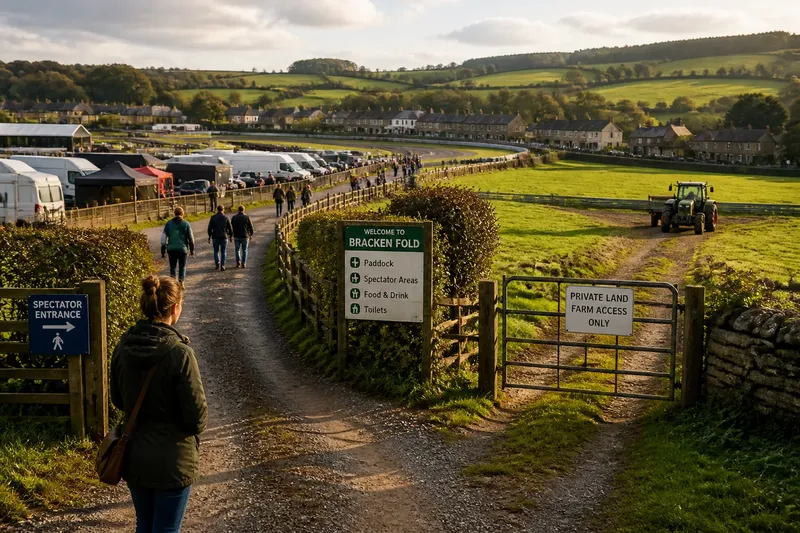
Near the entrance, a gravel lane leads past the paddock toward a pair of gates. One serves the venue; the other gives access to a neighboring field. A hedge, a posted sign and the lane’s direction tell visitors that the circuit and the farm meet here without becoming the same property.
Imagine Mara, an invented visitor who arrives expecting the circuit to feel self-contained. She notices a farm vehicle using the separate field gate, while visitors follow signs toward the paddock. The place becomes easier to understand: race-day activity occupies one set of spaces, while the adjacent farm continues its own work.
This kind of boundary gives a rural venue a distinctive social texture. A circuit on the edge of a village may share roads and sightlines with homes; one beside pasture may be bordered by gates and working tracks. The surroundings are neighbors, not props.
Access routes reveal how the venue fits its setting
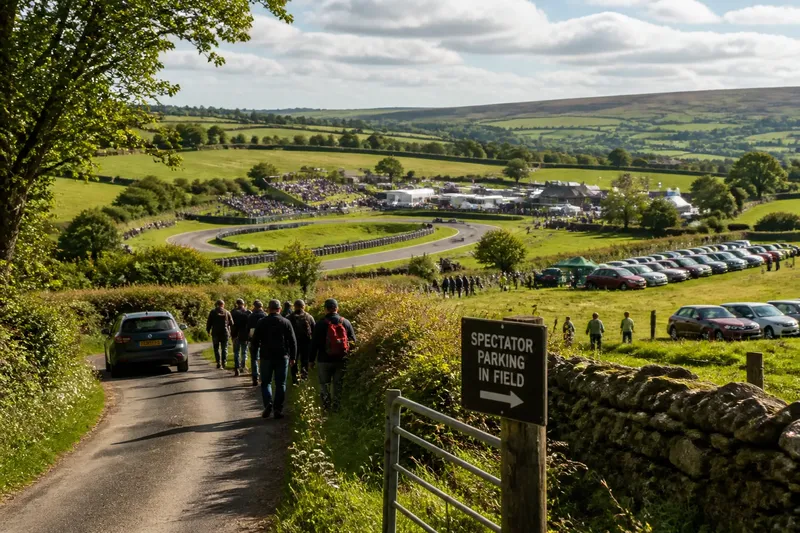
Approach roads can shape a visitor’s first impression before the course comes into view. A venue reached through a village street meets everyday traffic and local buildings; one approached by a narrow country lane may feel connected to farms and scattered homes. Neither arrangement is more authentic. Each tells a different story about how the circuit sits among nearby places.
At Bracken Fold, the visitor entrance opens onto a marked pedestrian route, while a separate lane serves neighboring land. Mara initially heads toward the field gate, then reads the sign and turns back toward the spectator entrance. That small correction shows why signs, gates and marked routes deserve attention: they clarify which spaces are public and which belong to others.
On a visit, follow the official route and respect closures, private property and local directions. A nearby lane may look like a convenient shortcut without being part of the venue.
Race-day customs grow around shared spaces
Rural circuits often have practical meeting places: the paddock entrance, a food stall near the spectator area, or a gate where visitors pause to check directions. The way people use these spaces can become part of a venue’s character. A familiar queue, a noticeboard or a regular gathering point says something about how the event is organized and experienced.
At the invented Bracken Fold, Mara sees spectators consulting a paper program near the paddock gate and volunteers directing arrivals from the public lane. She follows the marked path, buys food from a stall inside the venue and leaves the farm entrance clear. The result is a visit that fits the event’s flow without confusing public and working areas.
These customs are specific to a venue and its event, so avoid assuming every circuit follows the same pattern. Look for posted guidance and follow staff instructions; local habits are easiest to understand when visitors make room for them.
How can you read a countryside circuit’s identity?
What should I notice besides the track?
Look at entrances, neighboring roads, field gates, paddock access and the way signs separate visitor areas from private land. These details reveal how the venue operates alongside its surroundings.
How do I tell a public route from a farm lane?
Use the venue’s signs and marked visitor paths, and treat closed gates or private-property notices as boundaries. If a route is unclear, ask event staff rather than assuming that a nearby lane is open to spectators.
Do village-side and farm-side circuits feel different?
They can, because each has a different set of neighbors and everyday activity. A village-side venue may meet homes and local streets, while a farm-side one may meet fields, working gates and agricultural access roads.
What details make a useful description?
Name the circuit’s relationship to its surroundings, such as “a paddock beside the village road” or “an entrance shared with a farm-lane boundary.” Concrete details help distinguish one rural venue from another without relying on a broad label.
A short walk can clarify the venue’s identity
Say Mara begins with a simple question: where does the spectator area stop, and what lies beyond it? She starts at the signed entrance, follows the public route to the paddock, notes the separate field gate, then returns along the same path. Her answer is specific: Bracken Fold’s visitor spaces gather around the paddock, while the neighboring farm keeps independent access through its own gate.
That description does not depend on a sweeping view or a famous event. It comes from observable features—the signs, entrances and shared boundary—and from respecting the uses of land around the circuit. For a countryside circuit, those practical relationships are often the details that make its identity legible.
When you describe a countryside circuit, start with the places people enter, gather and leave, then name the neighbors its boundaries meet. That small shift turns “a track in the country” into a clearer account of how the venue belongs to its particular setting.